Art can be enjoyed as existing on the periphery of life. This seems to be the preference of the general public; stepping into galleries on lazy days, pausing in front of some sprawling mural on the side of an old factory, mounting printer paper scribblings on refrigerators. Minds turn away from whatever chores or work are in front of them, lured in by some framed print hanging surreptitiously on the wall, before returning to their course. There are some types, closer to the end of the spectrum pejoratively labeled "starving artist," who find this perspective to be lukewarm at best and insulting at worst. For them, life exists only in the pursuit of art. Truth about the human experience is found in the pictorial, the representational. We have no further to look than some painted tableau or sculpture or printed photograph, and then inside ourselves, to grasp what it means to live in this world. Photographer Aiko Verma is both none and all of the above.
After first toying with a camera at 14 years old, Aiko’s fascination with photography only increased in intensity in the passing years. She began as a hobbyist, but realized that the passion she has for communicating her perspective through the camera lens dwarfed her other academic interests, so with some introspection and outside encouragement, she chose to continue her work as a student at the Symbiosis School of Photography in Pune, India, where she is pursuing her Bachelors in Visual Arts and Photography. Despite being positioned at the precipice of what will no doubt be a fruitful career, Aiko has already found her photographic fingerprint in portraits and street shots with an emotional resonance that transcends simple representation of figures and scenes. Her work occupies this conceptual space that flickers between the art as an accessory to life and art as the essence of life.
Describing the freedom photography provides to create this space as "magical," Aiko asserts our shared instinct to keep moments of significance alive.
“Studying the art of photography has helped me to recognise how photographs are the testimonials of history and the present,” she says.
“How I see it, the world revolves around photographs. Everyone wants to capture the moments that mean something to them, people are surrounded by photographs, creating a world of their own.”
She explains that this natural inclination toward preserving these moments allows photographs to resonate so deeply with us.
“Photography [is] the optimal medium to convey any message,” she says “photographs move people, emotionally.”
One cursory glance over Aiko’s portfolio reveals her talent for coaxing out this mysterious characteristic of photography, as each photograph registers as familiar and otherworldly all at once, imbued with some peculiar quality that almost entirely escapes description because it is known in the second that our eyes settle on the silhouettes of three women in saris or the reflected gaze of the lone woman in “Ladies Special.” Aiko’s photographs beg not to be simply seen, not to be merely understood, but to be experienced. She summarizes her evocative aesthetic as the “link between reality and my vision.” That link is formed as Aiko chooses to isolate the subject in her photographs, by tweaking the composition, perspective, and even textural quality of the image so that the subject seems elevated above the setting without manipulating the background into obsolescence, and “creat[ing] a soft look that binds [her] vision to the reality in the photograph.”
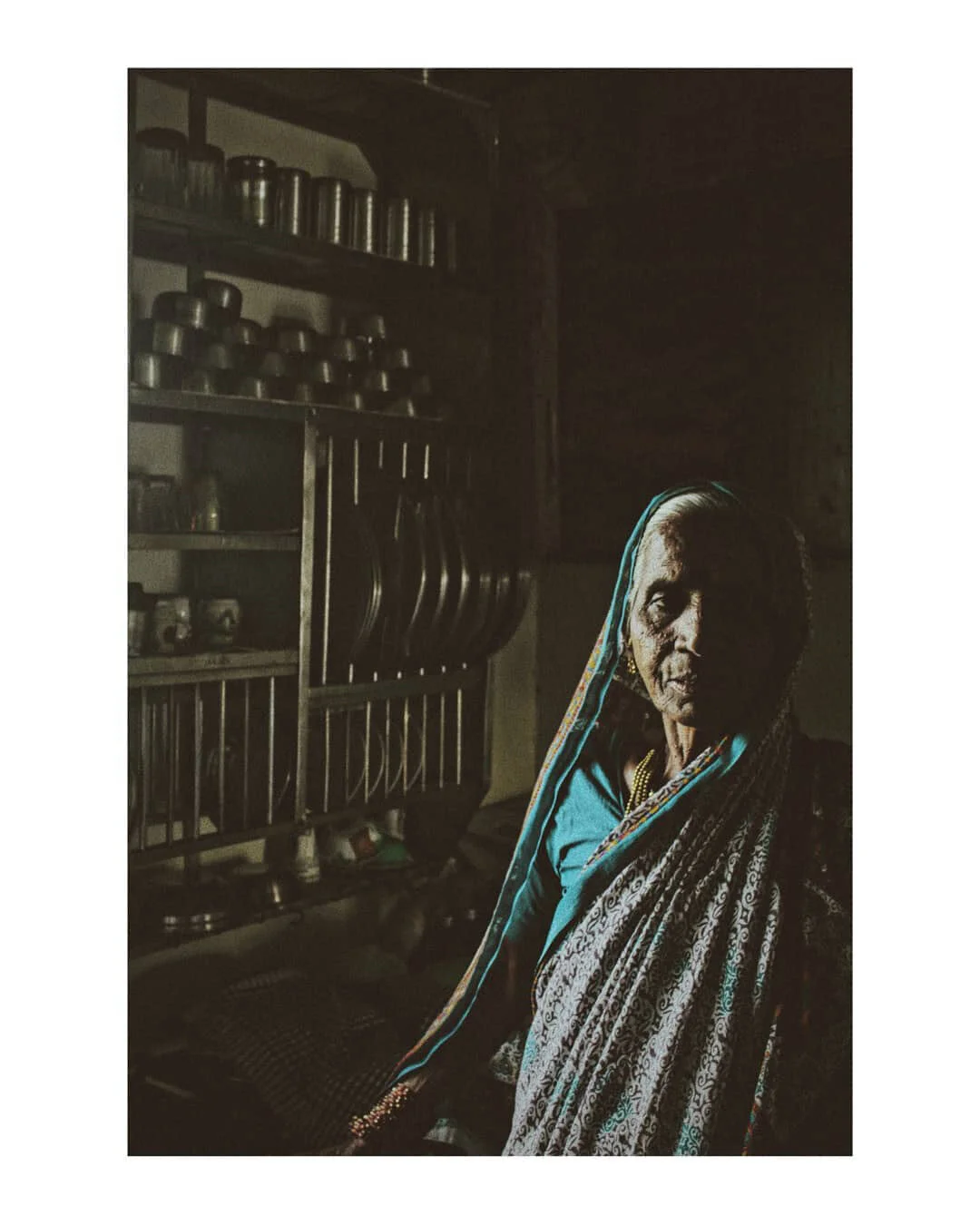
Photo from Aiko’s project Ladies Special
“In a life where everything is a rush,” Aiko says, “it becomes almost a fantasy for individuals and objects to offer more than a superficial meaning in their conventional settings.”
“Through my work, I like to put forward the same subject but in an “out-of-the-box” composition, in order to offer an imaginative outlook.”
This “imaginative outlook” Aiko extends to us is what makes her photographs so transcendental, because she presents us with portraits and scenes that activate an understanding that is not only rational, an understanding of the surface nature of the picture, but an understanding that is visceral and, in that way, gloriously human. We cannot know exactly what it is that Aiko’s muses are feeling the moment she snapped their pictures, but we also cannot help but wonder and try.
“Every time I create a photograph,” Aiko says, “I picture what the viewers would like to see, more like what the viewers would like to feel when they look at those pictures. I try to capture pieces of the subliminal emotions with which people relate to the world; the fragments of imaginations that the hustle of reality fails to offer. If vulnerability makes us human, then what is a better moment to capture such raw feelings than when the subjects are vulnerable?”
Engaging with these photographs is an exercise in empathy, as we must call upon our imaginative capabilities to gain entry to the internal world of those subjects, forever alive in ink or pixels. And as our own minds are churning with effort to understand the unknown of another, we find the photographs to be suspended in that space between the real and the abstract, the camp of art-from-life and the camp of life-from-art.
“Art, in any form, frees a person and their imagination,” Aiko says. “It becomes an escape from what’s real and defines reality by being so distinct from it.”
This process of imagination lures the photographs further from an objective meaning and, as it would seem, pure representation of the “real,” but it effectively nudges them closer to true reality, because the nature of subjective experience, which requires personal imagination, is the closest that we can come to that realization of true reality. The effect is astonishing; the photographs speak without demanding the assignment of language in the formation of that ultimate understanding.
Aiko echoes this automatic understanding in her artistic process, saying “I think that whatever I capture, it is already a part of the subconscious concept in my mind. I usually capture what moves me or talks to me without any words. When I look at my subject in the composition I want to capture, the concept flashes in front of my eyes.”
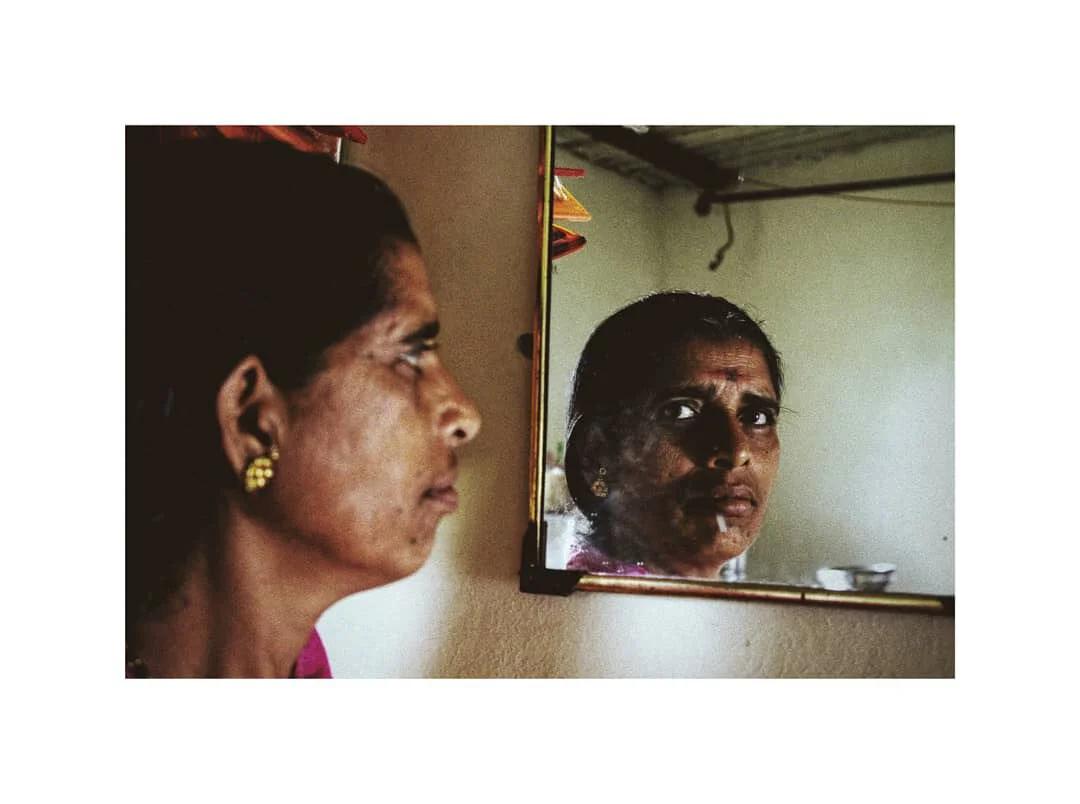
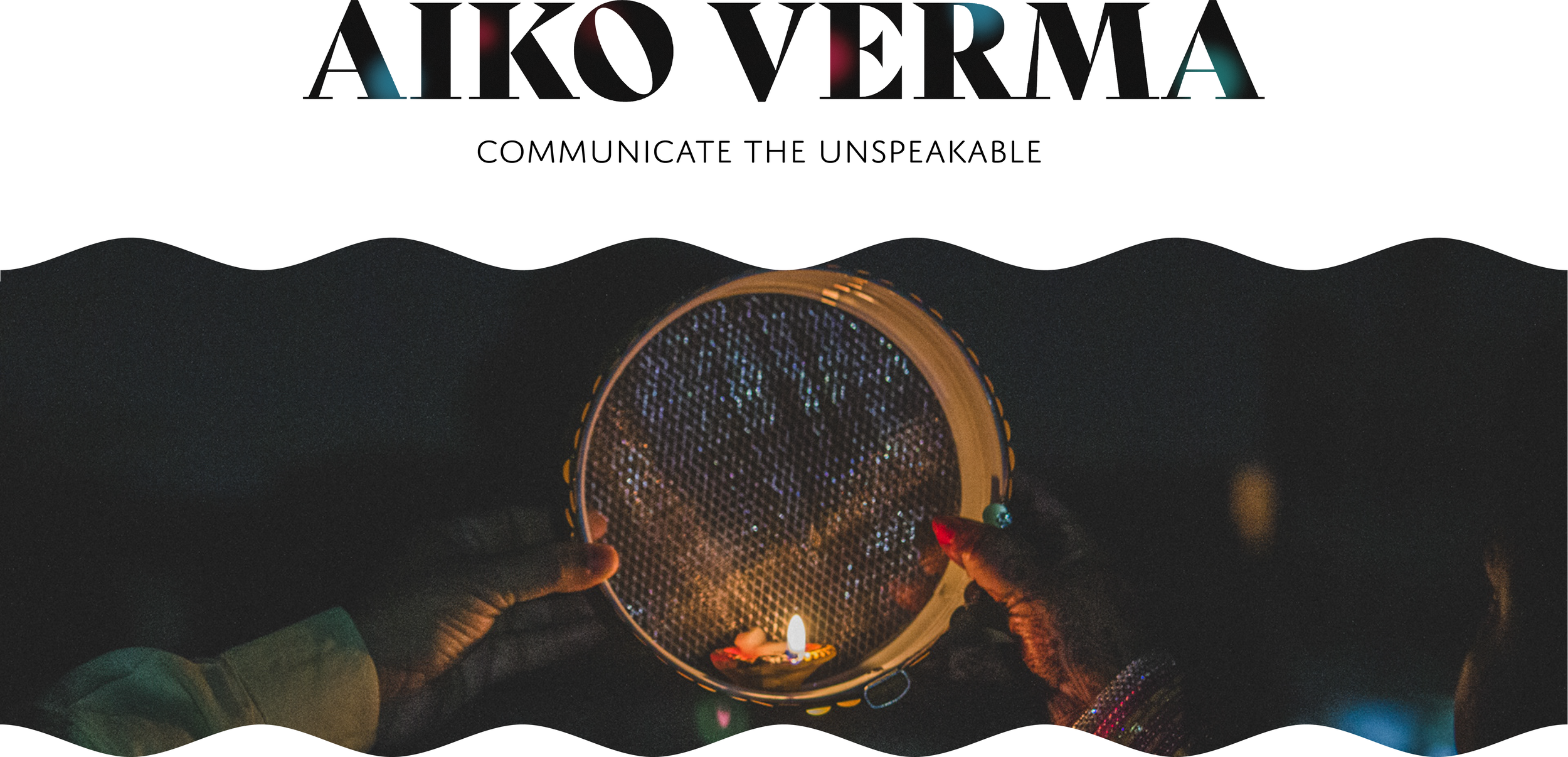
As we look upon the three women standing tall, draped in colorful saris and gold jewelry against the rocks, as we hold the gaze of the woman in the mirror, her face open and her eyes focuses, with our own, as we recognize the blue masks in the hands of the children, one of whom looks directly at us with an expression of that suggests too much, as we consider the hands, fingertips painted red, clasped or joined in lifting a candle, we feel our inner selves emerging to meet those in the photographs. Aiko creates these photographs to link her reality and her artistic vision and, in doing so, links together herself, the subject, and the observer by tapping into that thread of empathic connection.
Link by link, Aiko has created this chain that connects everyone who engages with her work---artist, muse, appreciator---in this loop of tacit understanding. And this chain has powerful implications on individual and collective scales.
“Art, for many, provides the freedom to either express or value individual interpretations,” Aiko says.
“It makes individuals who are suffering feel seen and heard. It makes them feel less alone because the feeling of being secluded creeps in even in a room full of people...I wanted people struggling to be seen, [and] I also wanted to create a picture of what the turmoil feels like so that others can be more empathetic and sensitive to others.”
It is through her photography that Aiko is able to communicate the unspeakable. Perhaps her message is unspeakable because any attempt to deliver it through simple language and visuals would be reductive and ultimately misleading, as that appeal to the mind would never be able to convey the complexity and ambiguity of the human experience.
It is impossible to explain the sentiment behind the photograph of the three women with any sort of verifiable accuracy, but somehow, we can appreciate the mixture of feelings inspired by the presence in front of our eyes.
Or perhaps her message is unspeakable because it is too grave. The photograph of the two children clutching surgical masks, the now-ubiquitous hallmark of an age in which suffering has been the reigning theme, we can only begin to grasp the magnitude of our shared suffering if we allow our hearts to lead our heads.
Aiko may know how she feels in her position as the photographer, saying of her experience taking these photographs, “I felt brave and free. I felt inspired to live my life despite the labels others give to my life. Maybe that's what my art has become to me. My inspiration. Being an artist, I realised that I appreciated the small things before I knew it. It is a beautiful and liberating feeling. ”
Aiko’s understanding of the nature of the unspeakable, and her understanding that we can only connect with each other by appealing to our emotional core, shines through her work. Aiko does not tell us what to feel, but rather provides us with what we need to feel it.