a string of unbothered speech rings
The work is suspended from the ceiling, and it hangs, too large to be consumed by a glance and too rich to be understood in a moment, in the open space of the gallery. There are rhombus shapes in cool tones, squashed and stacked tip-to-tip, that dominate the visual map of the work. Or maybe that is shallow interpretation; these rhombus shapes are artificial, an anesthetic byproduct of the zig-zag strips of textile, in perfect opposition, as if mirrored over the pink and blue tie-dye column bisecting the work, breaking the plane into geometric bites. An ochre strand snakes behind the rhombus-passing shapes and in front of the tie-dye column. Material darkness swoops under the zig-zags, sometimes pointed and sometimes curved, with pock-marks of white, like ghostly amoebas. The work is magnificent; that much can be said. But it does not give itself away. It does not offer up to you why you find it so beautiful. In fact, one gets the sense that it would never deign to squeeze onto some silver platter for easy consumption. The name, “Cut by Rivers,” does not help much in the reflexive mission of reduction into familiar motifs or comfortable words. We are already in too deep for geographic allusions or thematic symbolism. It does not reveal the secret meaning behind its elusive complexity. It does not even reveal if such meaning exists, and in what terms. It is the most elegant challenge because it does not tell you what it is. It just is.
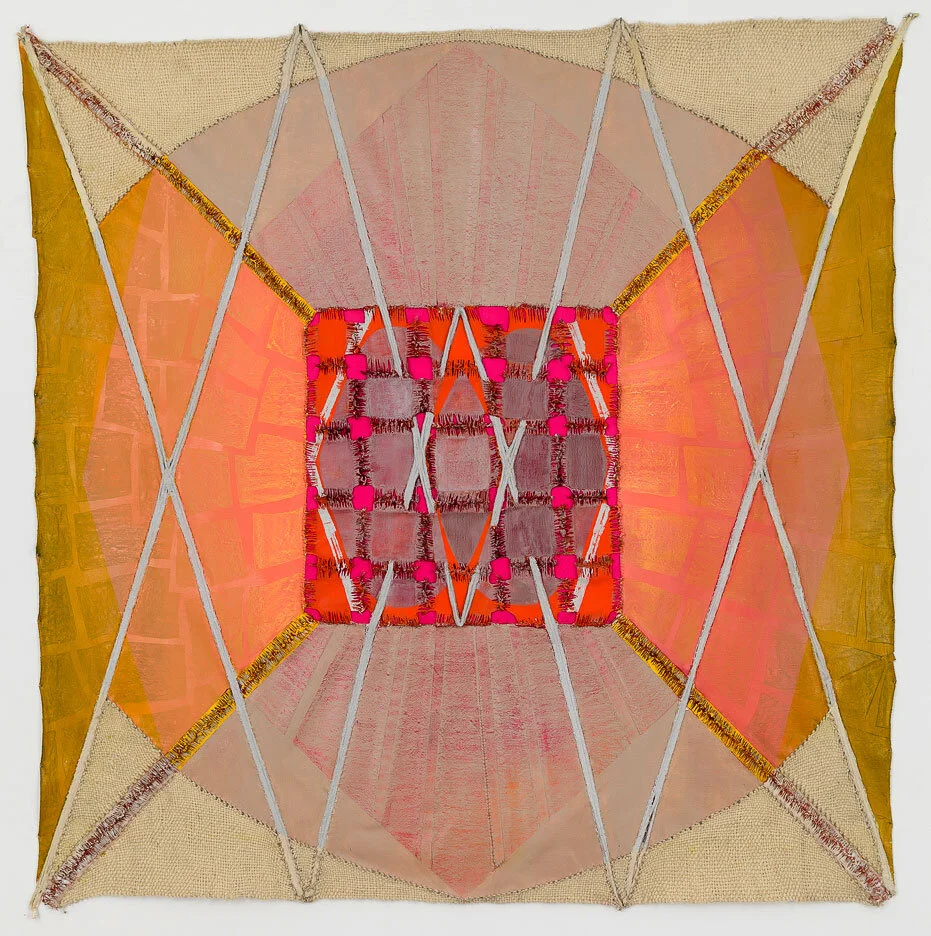
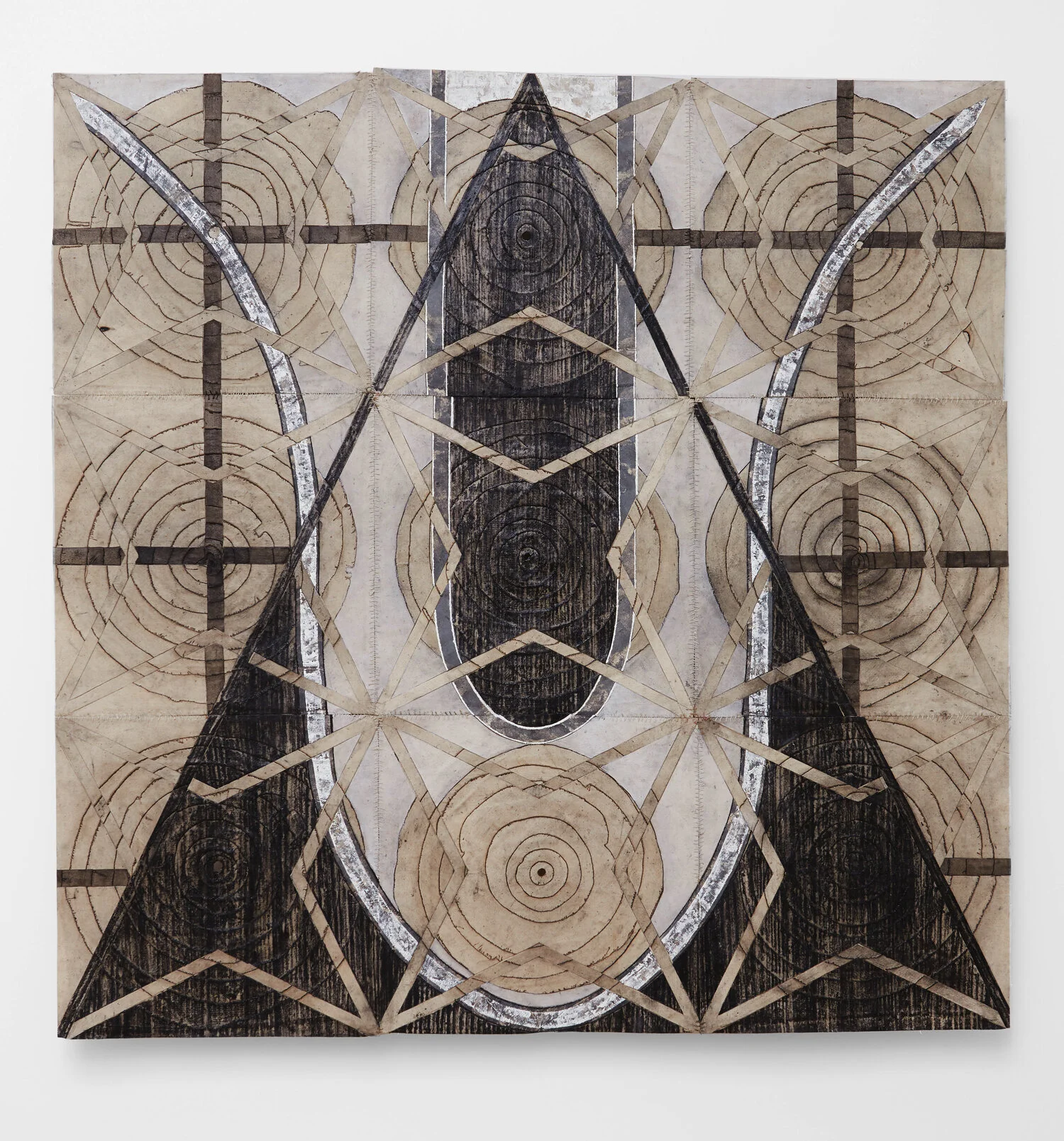
Artist Julia Bland is the creator of this work, and many others as mystifying, but she is not the Creator-with-a-capital-c. Certainly, it is through her imagination and her deft hands that these works were able to take form, first as pen scratches on grid paper and finally as large collages of hand woven textiles, burnt canvas, ink, hand dyed linens and silks, canvas, wool and linen threads, wax, hand twisted and braided ropes, and daubs of oil paint. She does not self-identify as the God of these works, however, even though one would have no grounds for denying her such an earned title.
Julia rejects the trope of the artist as the mastermind of her works, as an individual bestowed with genius lending itself to perfect conceptual genesis and perfect material execution. She does not acknowledge it by name but humility, coupled with restraint, is at the heart of both her creative philosophy and process. “My work certainly exists as, and maintains, a connection between my inner world and the world around me,” Julia says, “I am not totally aware of how it happens. It’s more about getting out of the way and allowing things to unfold. But, I don’t mean to say it’s easy, there is a lot of discipline involved. ”
In her production of art, she finds the opportunity to transcend the trappings of her limitations as an individual. Art is not a means to valorize her singular personhood, it is not an elaborate scheme to elevate her ego; it is a point of connection that she chooses to embrace rather than dominate. “The boundaries of what is considered art/not art are constantly changing. Art can and does challenge us, but it can also comfort and nourish us. It can strengthen our solidarity, and it can articulate our differences. Art is not really something that exists in a defined place or category, but something that must be discovered on its own terms, in its own context.”
There is an almost Zen quality here, in Julia’s explanation of her philosophy of art, that is frightening. To renounce micromanagement, to abandon the pursuit of what things ought to be, what they ought to look like and what they ought to say, and to submit the amorphous reality of artistic creation requires an earnest interest in creation for no sake but its own and an untold amount of self-control. Julia’s discipline, her refusal to weed out the contradictions and whittle down the spontaneity inherent to artistic creation, is what imbues her huge textile tableaus with their signature presence. Her artistic approach is similarly naturalistic. She recalls how her time in art school was spent discovering which ways of interacting with materials resonated the most deeply with her. “When I was a painting student at RISD [Rhode Island School of Design],” she says, “I found myself longing for a more physical relationship with the surface. I did lots of experiments, including folding, burning, ripping, and sewing the canvas. Many of these experiments evolved into processes that still play a large role in my work today.”
It is upon reflection of her work in those days that her intention becomes clear. “Looking back,” she says “I was not too interested in painting from observation, but I still wanted some kind of tangible relationship to my surroundings. I was interested in physical tension, material structures, gravity, and how these interactions produced imagery. I was interested in why our world looks the way it does.” Perhaps this contributes to the intangible but unmistakably sublime presence shared by Julia’s works. An appreciation for what registers as mundane to most, an appreciation that understands true beauty, primal and ancient, exists everywhere at once, an appreciation devoid of the instinct to dissect until all characteristics are reduced beyond resemblance.
To proliferate creation on “its own terms, in its own context” requires not only discipline in approach, but discipline in thought as well. Julia speaks of her work plainly. The way she describes her work with quiet confidence reveals an intimate understanding of her own relationship with a creation that only arrives after years of practice, and with the activation of an existing artistic intuition. She does not feel the need to dredge out every inch of her approach, in exhausting detail that somehow loses meaning with each added justification, and so her explanation stays honest through noncommittal prose. “The works all start from different places, from personal experiences, challenges I give myself, or as elaborations from previous works. Ideally, they are all of these things to some extent. My work takes a lot of time. If I am bored, I will never get through it, so I keep changing and trying new things all the time.”
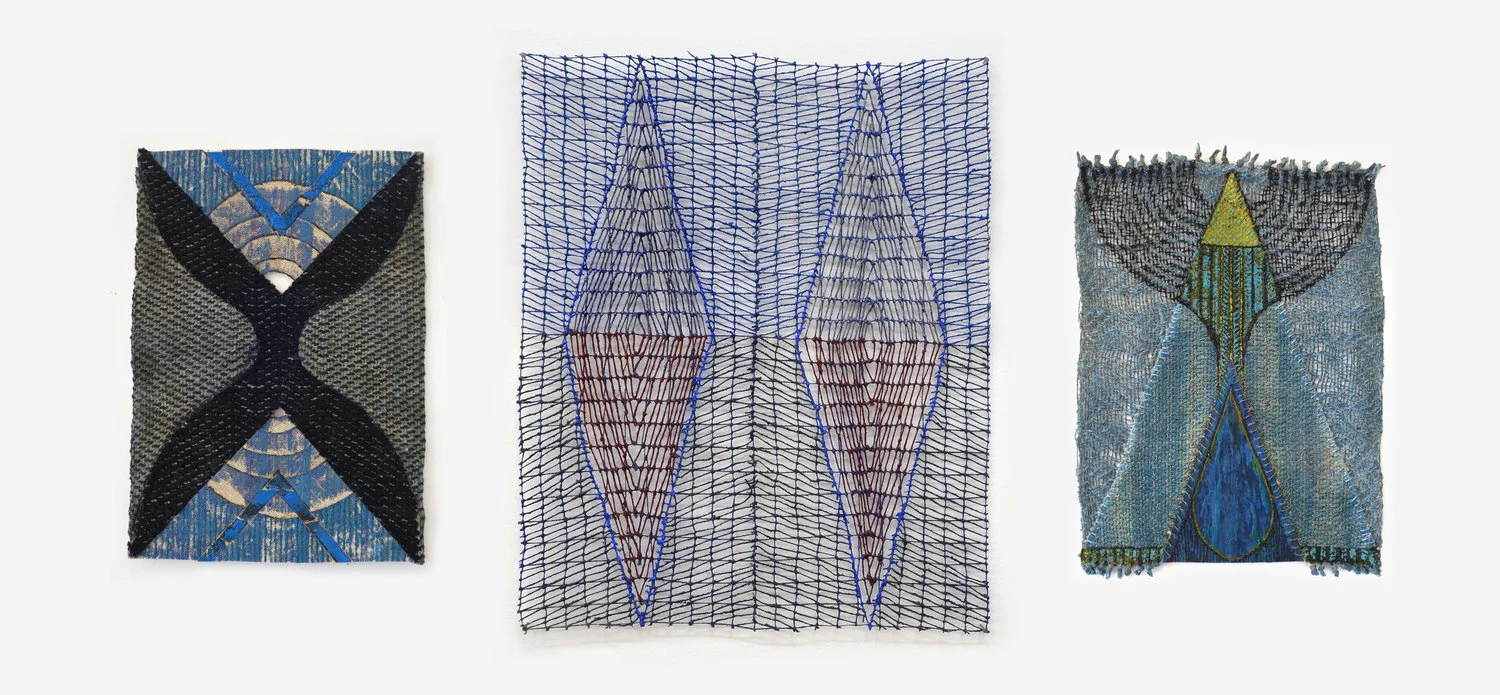
Much like how her works command attention and then scatter it in so many directions, Julia does not give it all away. Maybe there is nothing to give away and the mechanisms behind her works are as obfuscated to her as they are to everyone else, or maybe her subdued explanation was manufactured for that purpose; it is one of the mechanisms behind the ambiguous aestheticism of her works.
And so, in a string or two of candid speech, Julia sends us down the spiral that does not stop until we realize that it is only through our own impressions and experiences that some type of sense can be made of these works. For an effect or not, Julia’s unbothered speech rings as almost radical in this age of indulging public demand, and it echoes in her creative process. “It has never been productive for me to be overly concerned with technical ability or taste,” she says, “These concerns never get me anywhere good.”
When asked about what piece of advice she would give to aspiring artists, Julia answers with “One teacher of mine, Melissa Meyer, told me that eventually, the thing people don’t like about my work will become the thing that they do like about it. That was very good advice.” So Julia may surrender to creation as it is, imprecise and imperfect in both conceptual and material forms, she may find personal enrichment in the explorative capacity of art, rather than the opportunity it offers for domination, but she will not bend the knee to external pressures demanding an explicit explanation. She goes with the flow, but she will not be pushed. There is always a metaphor embedded in her pieces, but she will not read it to you. “In my experience,” she says, “meaning is something that people decide together. My work can mean a lot of different things, both to me and to other people. It’s important to me to maintain that openness. ”With this, Julia has placed in our outstretched palms the most terrifying gift: the freedom to decide for ourselves.
The work is still hanging. It does not make any gesture to present itself as something, anything distinguishable and finite. In vain, we try. We look at the shapes and colors, feeling ourselves shrink in their gaze, and we follow along the channels of our neural pathways, hoping that in some forgotten patch of memory, we will find the knowledge needed to establish some sense of the work. Our eyes dart around the work for recognizable elements: flying arrowheads leaving trails in hypnotic patterns, softly contoured bodies of floating jellyfish, marbled pillars, planets. And as we stand there, desperately trying to make sense of the work, we realize that it can only be done by submitting and allowing it to make sense of us.